Showing posts with label Flat World. Show all posts

Sunday, April 22, 2007

Neelabjo and I -Our early experiences with the Flat World

Posted by Picasa
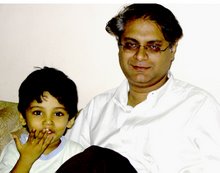
My son Neelabjo was born in March 2002..... he has been the center of my World , ever since .In this post , I trace back some early memories , in the context of the world that had since then started to become flat.

Ferrero Roche and Mysore

My brother in law , a PhD student in the University of Norte Dame , came down to meet his tiny nephew (31 December 2002) .We were based in Mysore , and for him it was a mini vacation in a city that he had not seen before. Like all US based NRI's , my bro in law (Raja) was carrying a consignment of chocolates (boxes of Ferrero Roche, Hersheys et al...) . My wife loves chocolates and she picked up more than a fair share of the booty. Just to give you a context , my in-laws are a large ( actually huge..) family spread across Uttar Pradesh , with a huge chunk residing in Varanasi , Raja had bought chocolates based on reasonable estimates of consumption (even for gluttons) ......but after the dent made by his beloved sister , his stock was in bad shape .....Raja stayed with us for three days , and on the second day (2 Jan 2003) tiny Neelabjo figured out a large shiny box ....and somehow picked it up and started walking . It was a box of Ferrero Roche chocolates -a jumbo pack ....little Neelabjo wanted it for himself ........he held it tight and even slept with it .....Raja was in a serious soup , what does he tell the innumerable aunts , and uncles ....who were waiting in Varanasi for chocolates from "Amreeka" a gift from their "Videshi Bhatija" . Well Raja was thinking of some creative excuses and planning to blame the customs officers for their greed etc etc ....he had mentally written the script which sounded reasonably convincing. That evening , I took him out to a supermarket (well not exactly one ,but a big utility store called Nilgiris..) , and i got busy buying grocery.Suddenly , I hear Raja's voice "Jamaibabu , peye gecchi " (Brother- in law , got it..!!!) for a moment i was stunned , what has Raja found ???......... , why was he so excited...the suspense was over in a second ..Raja had found a packet of Ferro Roche chocolates in Nilgiris Mysore at to top it up , at an Indian price . Raja took me to the confectionery section of the store which had all kinds of packs of Ferrero Roche chocolates .....Raja bought half the store to make up for the damage that his sister and nephew had done to his stock ....he left Mysore hoping that there was no Ferrero Roche outlet in Varansi , and later on he confirmed that there were none there , at least not till early 2003...... the world was beginning to get Flat


Golf Kits and Mumbai

In October 2003 , I visited Raja in South Bent , a University town 120 miles off Chicago . Raja was joined by his fiancee Supriya (now his wife) for the weekend. On one Saturday , Supriya took me shopping to a nearby WalMart store . I went to the toys section and picked up a golf kit for Neeelabjo for USD 25 . It was a pretty neat thing , and i liked it very much .....i thought that if Neelabjo takes to such fancy sports , it would help him to become a CEO ...(I am told most CEO's play golf )...so like a proud father of a future CEO , i took the golf kit back to Mysore ...and started giving Neelabjo golf lessons , he was big enough to walk unaided and I must confess that I was holding the golf club as a cricket bat ......We had a couple of golf sessions in the tiny play area of my apartment block . One day I was late from work and I saw something interesting , Neelabjo, his mom , a Coorgi kid and his mom were having a ball of a time playing a weird version of golf (but with two golf kits...) ....where did the next kit come from , surely this was not Ferro Roche that Raja could buy from Niligiris ...I went across to Mrs Carambaiah and asked her politely " has Mr Carambaiah been traveling lately ..", she said , "Yes , he had been to Mumbai and that's where he got the kit from ... and it cost him Rs 600.."

I lugged a golf kit across the Atlantic and thought that my son would be the sole proud owner of such a novel toy in all of India ....alas it was not to be in the Flat World ......


Jamaican Tiger

I am a slow learner , after the golf kit episode , I went to Jamaica for a consulting assignment . On my way back , I bought a Jamaican tiger ( a doll) for USD 30 . This was Feb 2004 , the same was available in Mysore for Rs 800...my plight with the Flat world continued

In conclusion

I love smoking , and i bought a lighter for 15 bucks a couple of weeks ago . I generally don't use a lighter , but i thought , why not buy those fancy ones....I used it for sometime and then it stopped working .....I went to the shopkeeper and complained to him and he without using the phrase , Flat World , said "China item sir , at China price, China quality.." , which essentially means enjoy it till it lasts .......I have stopped traveling abroad after I left Infosys which was three years ago and I am really happy that I am not buying stuff in US or Europe to find that the same stuff is sold in Mumbai or Bangalore for an India price ....Long live the Flat World ...


Saturday, April 14, 2007

Outsouring Backlash- A Myth ? Friedman explains ...

About 3 weeks ago , I had an e-mail exchange with a former colleague and CEO blogger Basab Pradhan on online tutions . The context of the e-mail discussion was my first post on online tutions titled "Extending the Offshore model-Tutorvista .Basab had written to me about the possibilities of an offshore backlash creeping back in the US lead by noted economists like Alan Blinder (former Clinton economic advisor ) ......the notion of the downturn brought me back to 2001 -02 when the IT industry in India was hit badly...is it going to happen again was the question that I asked myself...I read up press clippings and interviews of Nandan Nilekani and the top brass at Infy and they seemed to say it was "Business As Usual" .....were we missing something !! .....i searched the net for possible clues which would give me a better handle of the situation and in this quest I found an interesting interview of Thomas Friedman by Yale Global editor Nayan Chanda. Chanda expressed his concern about Alan Binder's comment in the WSJ saying that 40 million American jobs are going to be lost due to outsourcing.....

Friedman opined that Binder knows that jobs will become fungible and flow to the point where it can be delivered most efficiently....this is bound to happen in the flat world ...The key question is how does the US cope with the job loss ...the answer partly lies in the interview that Friedman has given to Chanda and more details would definitely be available in the third edition of Friedman's book ...

For the time being it does not seem that the backlash is something that Indian IT services is really concerned about , Nandan , NRN , Kris and Shibu seemed perfectly calm in the CNBC boardroom interviews after the quarterly results of Infy were declared yesterday....despite Friedman's theories , and the buoyant mood of the captains of the Indian IT industry...I sincerely hope that we are not missing something here ......

Monday, April 9, 2007

The Survival Mantra for Indian IT/ITES industry in the Flat World is Global Delivery and not delivering from India ??

There might be many definitions of the Flat World, the one that I connect to most is “a flat world is a place, where goods and services are produced in location(s) where its cheapest and most efficient to produce and sold in locations which are most profitable…”. This definition would be the one that the Indian IT/ITES industry would be happiest about…after all we continue to be a low cost producer of IT and BPO services .

However there is a twist to the definition, ….as an Indian you might want to believe that offshoring to India will continue unabated because of the labor arbitrage.......unless we pay heed to the latest trends in the BPO sector . The research done by Sujay Chohan and Robert H Brown of Gartner opines that the distinction between onshore (services delivered in the country where the contract is signed) and offshore (services delivered from a country other than the country where the contract was signed) is increasingly becoming irrelevant as “offshore providers” move outside their home countries and set up global delivery centers and as “onshore providers” set up centers in low-wage countries. This trend is also driven by the need to outsource increasingly complex processes that are end to end, encompass several countries and touch the client's various locations. This would mean that the relevance of India as the best offshore location automatically comes down and the shift from offshoring to India to global delivery is distinct and is borne out by data. Indian service providers like Wipro , WNS, Infosys BPO(formerly Progeon) , HCL , TCS, Genepact, Hinduja -TMT and Transworks have acquired or set up delivery centers in several countries to serve their clients onshore and offshore . The Aditya Birla Group's take over of Minacs and consolidating its ITES business as a combination of Transworks-Minacs gives it an automatic global delivery footprint (Minacs had many non-US delivery locations)

According to Gartner by 2008, most successful BPO service producers will have service delivery centers (not just sales offices) in at least 3 countries

a)An onshore location (typically where the contract is signed)
b)An offshore location (country where the company is headquartered)
c)An additional delivery location independent of these two categories

Now that I have put the offshore versus Global delivery in some perspective, I would like to draw your attention to the parallels in the IT services space. Infosys takes pride in its Global Delivery Model (GDM) , which was for many years delivery out it's various Development centers in India , till it set up some small PDC’s (or Proximity Development Centers) in UK , New Jersey and Canada. This was pretty much the trend till 2004 (delivery primarily out of India , with a few PDC’s onshore ) ,but with the setting up of Infosys China which has a significant workforce is also a strong step in the direction of the “true GDM” . What is happening in the BPO space is also being replicated in the IT Services sector albeit a bit slow. Therefore it would be safe to say that the flat world is not a place where an Indian service provider can survive by delivering from offshore …it is time to go global ….. . The process of going global requires developing new mindsets and new skills …the automatic question is what are these? ….I did not have answers till I chanced upon a speech at IIM-B given by the leader whom I admire most ,Nandan Nilekani . In his speech at IIM-B,Nandan talks about the a new hybrid manager – the ‘Versatilist’.

I am not saying that this post is a wake up call for the Indian IT/ITES industry but I would like to leave my reader with a thought that global delivery is indeed a reality and it is imperative to look at it with a heightened sense of urgency and not be satisfied by servicing customers from Indian locations alone......

Wednesday, April 4, 2007

Flat World-It's unintended consequences

I have been thinking and writing about the Flat World for almost three months now , profoundly influenced by Thomas Friedman’s work . However , we the Flat-world types need to also explore the unintended consequences of the Flat World which has been captured rather well by Shreyasi in her post . The instances like the North Korean interception , the Bali bombings rightly exemplify the geo-political consequences of the Flat World .

In addition to her article , a similar post by Pashos Mandravelis draws the connection between technology and terrorism . I was alive to the consequences of the Flat World , but after reading these two articles (by Pashos and Shreyasi) , my concern over the consequences of the Flat World has been heightened and my key concerns are as follows :

The people who bear the consequences of technology applications for terrorism are in most cases those who are in the bottom of the globalization food -chain - "The Common Man". Does the common man have a say on what technologies are dangerous and can he prevent these technologies reaching the terrorists - my suspicion is a big NO , technology is after all knowledge and knowledge cannot be stopped with wired fences ...so the common man has to suffer as new technologies and processes which are flattening the world also find some applications to spread terror and death ......

The developed nations are the early beneficiaries of the Flat World , and within the developed nations , the wealthy .......these are the people who put Podcasting to meaningful use , travel across the world and use google as an information mining tool et al ....but they are a very small fraction of humanity ...the question that I would leave you with is

If the Flat World does not lead to inclusive development ( I am sure it eventually will , but the process might just be too slow and the sharing of economic benefits maybe skewed disproportionately to the wealthy nations ...) , then why do we need a Flat World ...what good is it , if it cannot lead to common good for the greatest number .....??

Do write in , would love to hear from you

Saturday, March 31, 2007

Social Networking sites as a political campaign tool -Orkut

I had recently written about the use of technology in the political process (YouTube as a tool for political campaigns) , and it's possible implications in the Indian context a decade from now. Building on the same theme is an article in the Washington Post (dt 30 March) which makes the pattern clearer . This article is about US Presidential candidate John Edwards using social networking sites as a campaign tool and also a distribution channel for campaign materials and content . He is on all the big ones: Flickr, YouTube, MySpace ,Facebook, et al, ...not including his own OneCorps which is supposed to have 20,000 members . In addition to this his own website has a blog feature, podcasts , RSS feeds etc etc . According to observers of the 2008 US Presidential polls , Sen. Barack Obama ,judging by the number of friends on MySpace or number of views of his YouTube videos, may be the most popular online candidate....interesting way of assessing electoral fortunes of candidates isn't it ?

In my previous post I had mentioned about the possible applications of the YouTube as a campaign tool in India about a decade from now.....in the light of the Washington post article and the state of Internet usage in India....I am tempted to beleive that social networking sites have a significant role to play in political campaigns in India as well.....


The number of people who are members of an Orkut community dedicated to one or more political parties is insignificant at this point in time , but nevertheless growing rapidly .All major national political parties and regional ones like DMK , BSP , SP , TDP , TMC, CPI(M) etc ...have a community in Orkut and the members range from hundreds to thousands . If one goes through the profile of the members of this community , its not necessarily the urban Indian youth . A quick glance of the membership profile of these communities would reveal that there is a fair percentage of people from the semi-urban and rural India . I randomly looked at the posts of the Samajwadi Party -orkut community and it was not surprising to see that community members are already using it as an election tool .

In addition to the Orkut communities dedicated to specific political parties , there are communities based on locations -for instance , there are communities dedicated to Navi Mumbai and also for Nerul ( a nodal town in Navi Mumbai ,where I presently reside..) , it will not be long before the local corporator starts using it to reach people in his constituency (Nerul has 2,000 members and Navi Mumbai has almost 7,000 members...and these numbers are growing rapidly) . Cynics will call it 'the spray and pray strategy..... try what you can.....see what sticks," . While at this point in time , given the numbers and the Internet penetration in our country it could be "spray and pray" , but I believe that with the rise of usage of social networking sites (across India) and the increase of bandwidth will make this a reasonably viable channel for electoral battles .......what do you think ?

Thursday, March 29, 2007

Extending the offshore model - Tutorvista

The financial viability of the Indian offshore model has been proved beyond doubt by the India IT services industry. However in-spite of the growth of the IT services business, it is important to extend the offshore model to other areas of professional services. In an earlier post I had indicated possible areas where the offshore model could be extended seamlessly, my favorite being learning management. I had discussed this idea with Basab Pradhan –CEO of Gridstone Research and a former colleague of mine from Infosys. Basab listened to my idea with great attention and opined that for an offshore service to be successful it’s important to ensure that the “degrees of freedom” for the client is minimized. He essentially meant that the customization requirements must be kept under control. According to him learning management runs a risk of high degree of customization of content (based on the clients ever changing needs…), which could probably make it difficult to build a scalable business model. Basab’s concept of “degrees of freedom” stayed with me and I started scanning the environment for possible ideas which could extend and or redefine the offshore model and its applications beyond IT services………… I found the application .....in the offshore tution model that Tutorvista has developed …….

TutorVista, is a Bangalore based online tuition's company , which aims to attract middle-class parents by providing online, one-on-one access to Indian tutors at rates far below those of conventional tutors in the US or UK . Tutorvista recruits Indian graduates and after an extensive training on the company’s technology and the accent neutralization assigns them students. Unlike learning management, wherein the content can be debated by the client and therefore is susceptible to multiple design iterations, an offering like online tuition's can be standardized if Tutorvista adheres to national and state standards and is fully cognizant of the requirements of the local school district or student's college. If tutors use the same textbooks and reference materials it ensures that the tutoring is relevant and useful. Tutorvista has signed up 950 students in the US and has recently tied up with publisher HarperCollins to provide the same service in the UK.
I have contacted K Ganesh the CEO of Tutorvista, and he has agreed to give me an exclusive interview on the business model, the value proposition and his vision for the company …..Keep an eye on my blog to learn more about Tutorvista and how it’s the next big thing out of India…….keep reading ….

Saturday, March 24, 2007

Flattening of Politics -YouTube


Technology and the internet is changing the way knowledge and content are being created, shared and debated and also challenging the notion of "content is king" . Three companies that have done well during the post -bubble resurgence are Google , Apple and YouTube . None of them create content , they distribute it ......YouTube is one of the latest kids on the block which has created a huge market cap riding on the back of content created by others . Founded in Feb 2005 , YouTube is a popular free sharing video website which lets users upload, view, and share video clips .

Politics has recently found an application for the YouTube . Political candidates for the 2008 Presidential election have started using YouTube as a channel for advertising their candidacy. Voters can easily look up propaganda and make videos supporting or demoting presidential candidates of their own, specifically those for Obama and Hillary Clinton .

YouTube creates an avenue for easy distribution of campaign material , therefore changing the rules of the election game significantly. If you do a search on "political campaigns" in the YouTube website , the amount of available content is significant

I am hoping to see Indian political parties use this as a campaign tool within the next ten years (ten years because it will take that much time for a critical mass of internet penetration in our rural areas for it to be of use to the political parties ) . Hopefully if political content is shared seamlessly, the significant by-products of such a process are :

a) Politicians will be forced to promise what they can deliver

b) Responsibility and accountability in the campaign process (now the entire content will be available on the world wide web and hence the political parties cannot have selective amnesia)

c) Issues of national importance can be documented , archived and retrieved by a common voter , who can then use all this data to make an informed choice .


The YouTube has the potential to change the way political campaigns work and hopefully it will make a big difference to the political processes in our country........


Friday, February 16, 2007

India's Competitiveness -Flatten the World through technology and offshoring

I have many friends in the IT services sector who have this belief that someday India will lose its cost arbitrage advantage and the growth of IT services would really come down , slowing down the economy in general . What might probably happen that the rate of growth may see some correction , but overall we have scratched only the surface of professional services .

It is imperative to ask ourselves why is the Indian offshore model has been applied only to professional services like the IT services, while there are other huge businesses like payroll processing, outsourcing services like Learning Management , Talent Development , Supply chain management (ex-UPS)

I believe the it is time to flatten the world further and use our Technology prowess to continue build our competitiveness . It is interesting to note that Unilever has outsourced its Learning Management and some other Hr processes to Accenture at a fee of USD 1 bn (check out Accenture Learning Systems
http://www.accenture.com/Global/Services/By_Subject/Business_Process_Outsourcing/Accenture_Learning/default.htm).

While this is not a fully offshoring process but am sure India can provide content development and management service to large organizations . The question is who takes the lead....... and look at areas beyond IT services , the time has come to take the process of flattening to the next orbit.

Also check out (http://thinkflat.infosys.com/why-think-flat_perspectives.asp) for additional perspectives